
Selling a house in Grand Junction typically costs between 2.5% and 5.5% of the sale price, depending on whether you offer to pay the buyer’s agent. On a $450,000 home that is roughly $11,000 to $24,500, and the largest piece by far is agent compensation. The good news is that the largest piece is also the most negotiable.
Here is the full line-by-line breakdown, so you can estimate your own net before you ever sit down with an agent.
What are the actual costs of selling a home in Mesa County?
There are five cost categories a Mesa County seller should expect. Three are small and fairly fixed. Two are large, and those are where your money is actually won or lost.
| Cost | Who typically pays | On a $450,000 sale |
|---|---|---|
| Listing agent compensation | Seller | $9,000 (Greyhound, 2%) – $13,500 (3%) |
| Buyer’s agent compensation | Negotiable since 2024 | $0 – $13,500 |
| Owner’s title insurance policy | Seller, by Mesa County custom | $1,752 |
| Closing / settlement fee | Usually split | $165 (of $330 total) |
| Prorated property taxes | Seller, through closing day | Varies by closing date |
The two compensation lines are the only ones large enough to meaningfully change your net. Title and closing together come to $1,917 — well under half a percent. Both scale with the sale price, so confirm your own figures with the title company.
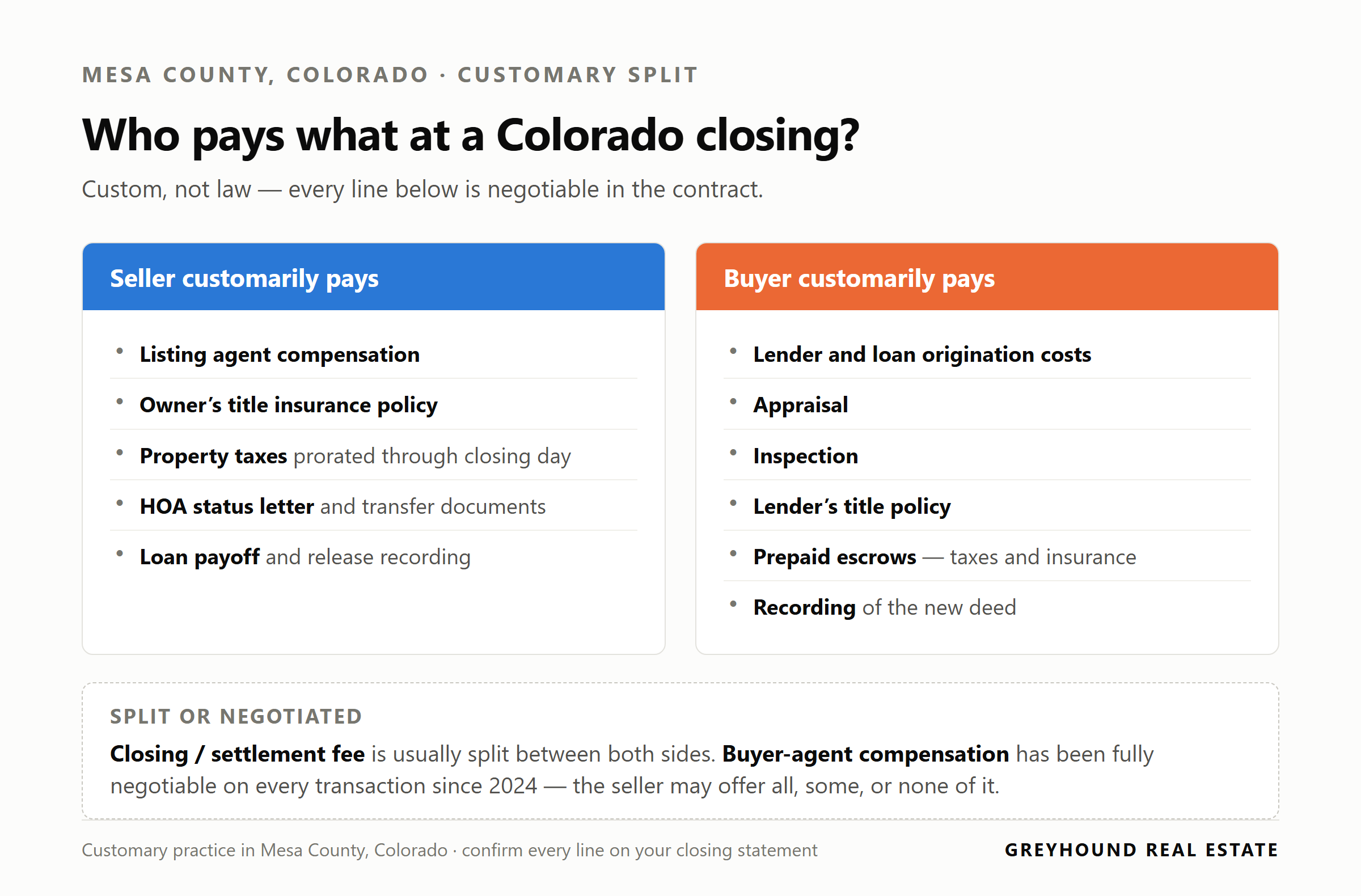
Who customarily pays what at a Mesa County closing. Every line is negotiable in the contract.
How much is listing agent compensation in Grand Junction?
There is no standard rate, and there never legally has been — rates are set by each brokerage. In the Grand Junction market, listing-side compensation commonly runs 2.5% to 3%. Greyhound’s listing fee is 2%.
On a $450,000 sale, that difference looks like this:
| Listing compensation | What you pay | Difference vs. 2% |
|---|---|---|
| 3.0% | $13,500 | +$4,500 |
| 2.5% | $11,250 | +$2,250 |
| 2.0% (Greyhound) | $9,000 | — |
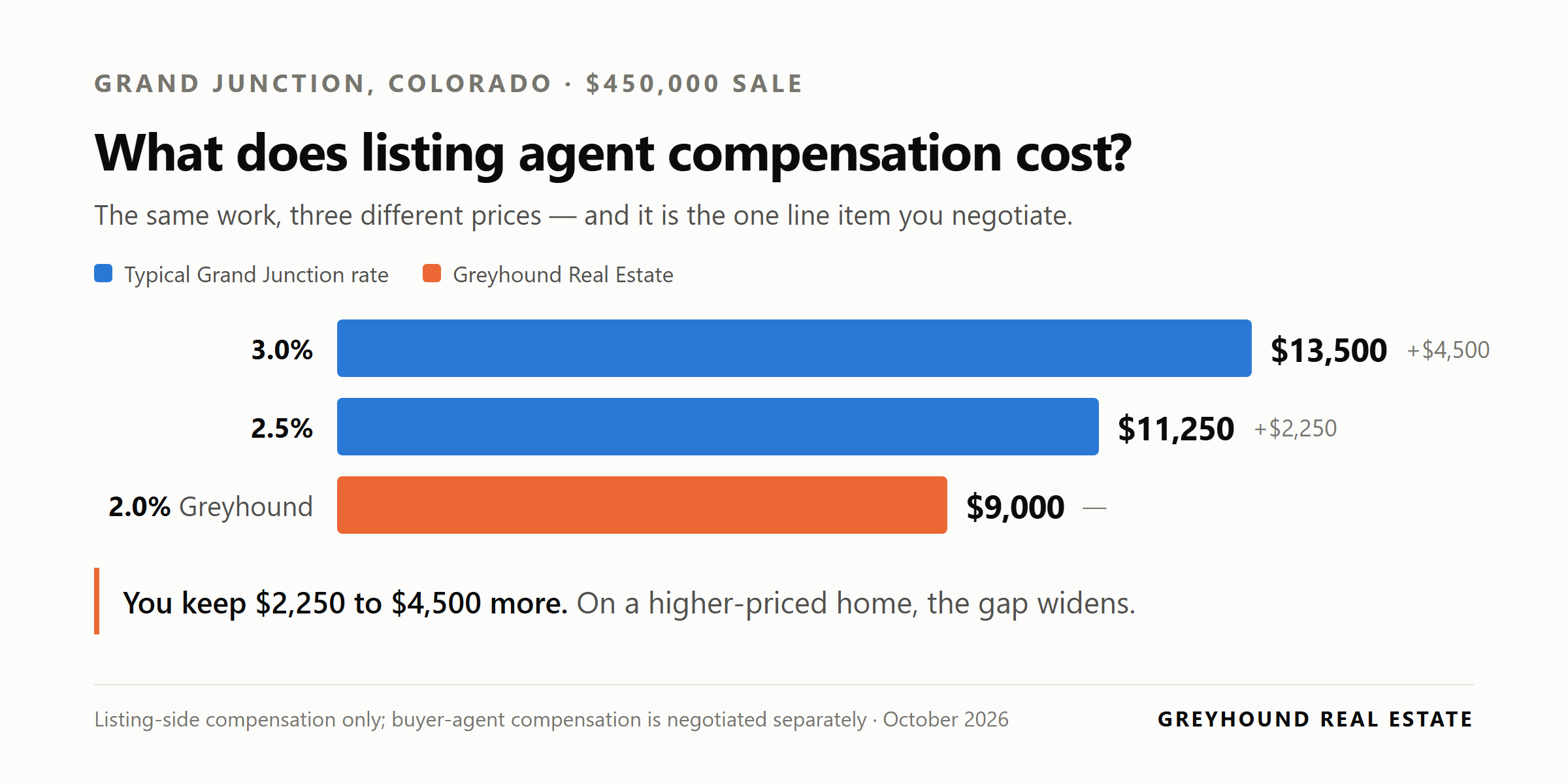
Listing agent compensation on a $450,000 home at three common rates. Greyhound’s 2% keeps $2,250 to $4,500 more in the seller’s pocket.
I have also seen sellers in this market pay as much as 4% on the listing side. It is uncommon, but it happens — which is exactly why it is worth asking what the rate is before you sign anything.
That is $2,250 to $4,500 kept, on one line item, for the same work: pricing, photography, MLS entry, marketing, showings, negotiation, and managing the contract through closing. On a higher priced home the gap widens, because it is a percentage.
A fair question to ask any agent quoting you a higher number: what specifically am I getting for the difference? If the answer is a list of things every listing agent does anyway, that is worth knowing before you sign. Here is what a listing agent actually does, so you can compare like for like.
Do sellers still have to pay the buyer’s agent in Colorado?
No. Since the 2024 changes to how buyer agent compensation is handled, offering to pay the buyer’s agent is negotiable on every transaction, and it is no longer advertised in the MLS.
In practice, Mesa County sellers are choosing among three approaches:
- Offer nothing. Keeps the most money, and narrows your buyer pool dramatically.
- Offer a set amount or percentage up front. Markets the home to the widest group of buyers.
- Leave it open and negotiate per offer. The most common approach right now, and usually the most flexible — you decide when you have a real offer in front of you, not before.
There is no universally correct answer; it depends on your price point, your timeline, and how much competition your home has. This is worth a real conversation before your home goes live, because the decision affects how your listing is priced and positioned from day one.
What smaller costs catch Grand Junction sellers off guard?
Four, usually.
Prorated property taxes. Colorado property taxes are paid in arrears — you pay this year for last year. At closing you credit the buyer for the portion of the year you owned the home, which comes out of your proceeds. Sell in November and that number is most of a year’s taxes. Sell in February and it is small. Separately, if you still have a mortgage, the money sitting in your lender’s escrow account is not lost — once the loan is paid off in full, the lender refunds that balance to you directly, usually within a few weeks of closing. Those are two different pots of money, and sellers routinely confuse them.
Loan payoff interest. Your payoff figure is not last month’s statement balance. It includes interest accrued to the actual closing date, plus any recording fee to release the deed of trust.
HOA status letter. If your home is in an association, the HOA charges a fee to produce the status letter and transfer documents. Colorado caps what they can charge, but it is not free, and it is the seller’s cost. Order it early — a slow HOA is one of the most common causes of a delayed closing.
Negotiated repairs or concessions. After inspection, a buyer may request repairs or a credit. This is impossible to predict and is a genuine reason not to spend your last dollar before you close.
What will I actually walk away with?
Your net is the sale price minus your mortgage payoff, minus the costs above. The worked example below uses $450,000 as a round number for easy math — not as a prediction of your home’s value.
| Line | Amount |
|---|---|
| Sale price | $450,000 |
| Listing agent compensation (2%) | −$9,000 |
| Buyer agent compensation (if offered, 3%) | −$13,500 |
| Owner’s title policy + half the settlement fee | −$1,917 |
| Prorated property taxes | varies |
| Estimated net before mortgage payoff | ≈ $425,583, less prorated taxes |
For context on where $450,000 sits in this market: the median Mesa County home sold for $428,500 in July 2026, per GJARA Paragon MLS.
Any agent can produce a seller’s net sheet for your specific address, your specific payoff, and your specific target closing date. It takes about fifteen minutes and costs nothing. If you are even thinking about selling in the next year, get one — it is far better to know your number now than to discover it three days before closing.
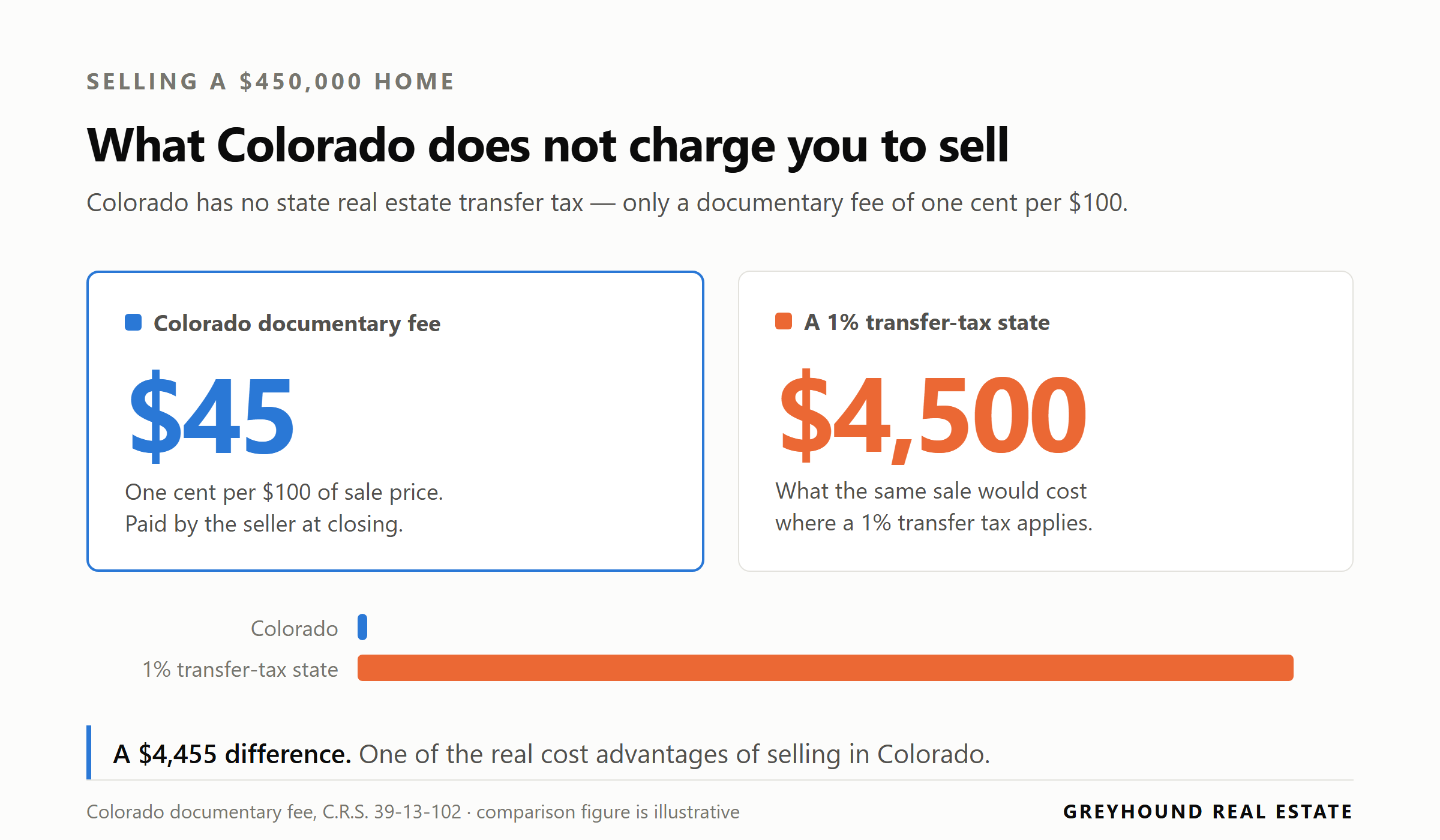
Colorado has no state real estate transfer tax — one of the real cost advantages of selling here.
Frequently asked questions
What percentage do most real estate agents charge in Grand Junction?
Listing-side compensation in the Grand Junction market commonly runs 2.5% to 3% of the sale price, and occasionally as high as 4%. Greyhound Real Estate charges 2%. Rates are set by each brokerage and are always negotiable — there is no standard or required rate in Colorado.
Does the seller pay closing costs in Colorado?
Sellers pay some and buyers pay others. In Mesa County, the seller customarily pays for the owner’s title insurance policy and prorated property taxes through the closing date. The settlement fee is usually split. Buyers pay their own lender and loan costs.
Do I have to pay the buyer’s agent?
No. Since 2024, buyer agent compensation is negotiable on every transaction in Colorado. You can offer nothing, offer a set amount, or decide offer by offer.
When do I pay my real estate agent?
At closing, out of your sale proceeds. Greyhound charges nothing up front — if your home does not sell, you owe no compensation.
Thinking about selling in Grand Junction, Fruita, Palisade, Delta County, or anywhere in the Grand Valley? Start with a free seller’s net sheet and a market analysis of your specific home — no cost, no obligation. See how we sell homes for less or learn more about our Grand Junction market coverage.
📲 Jennifer Cirka, Broker/Owner — 970-270-5757
📲 Mark Crego, Broker Associate — 720-855-5273
🌐 GreyhoundRealEstate.com